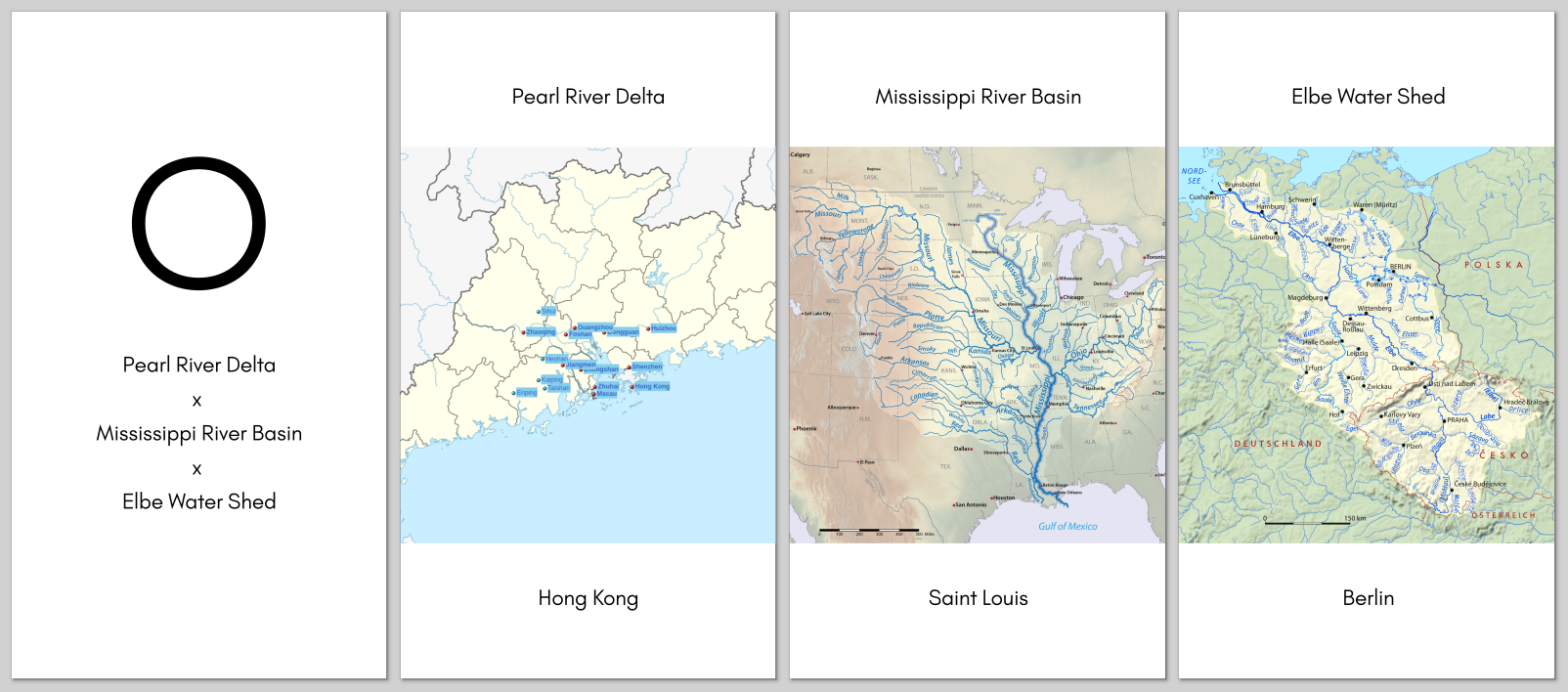
This writing explores the conceptual and geographical rivers winding through by Oui.gallery, tracing its progression through three iconic water-based regions: the Pearl River Delta, the Mississippi River Basin, and the Elbe Watershed.
In the world of contemporary art, geography is often treated as a static backdrop—a white cube in a specific zip code. However, Oui.gallery operates on a different frequency. By positioning itself in Hong Kong, Saint Louis, and Berlin, the gallery isn’t just opening branches; it is tracing a narrative of global trade, post-industrial transformation, and the fluid movement of culture.
At first glance, these three locations seem disparate. One is a hyper-dense financial titan, one is a resilient American heartbeat, and one is the experimental soul of Europe. But look closer at their waters—the Pearl, the Mississippi, and the Elbe—and you see the same story of human ambition, ecological crisis, and artistic rebirth.
1. The Pearl River Delta (Hong Kong): The High-Speed Gateway
The journey begins in the Pearl River Delta (PRD), specifically Hong Kong. Historically, this was the gateway where the East met the West through trade. Today, it is one of the most densely populated and economically productive regions on earth.
- The Vibe: High-velocity, vertical, and neon. It is a place of extreme proximity where global capital meets local heritage.
- Global Issues: In Hong Kong, the dialogue is often about space—the scarcity of it, the cost of it, and the political reclamation of it. The PRD represents the pinnacle of “The Global City,” where the river is a highway for cargo ships and a backdrop for a skyline that never sleeps.
- The Art: In this context, Oui.gallery taps into a scene that is both ultra-commercial (Art Basel HK) and fiercely independent. Artists here often grapple with identity in a shifting political landscape and the physical constraints of urban life.
2. The Mississippi River Basin (Saint Louis): The Industrial Heartbeat
Moving westward, the progression lands in Saint Louis, Missouri. If Hong Kong is the future, Saint Louis is a poignant reflection of the industrial past and a gritty, hopeful present. The Mississippi is the spine of America, and St. Louis was once its “Gateway to the West.”
- The Vibe: Wide, horizontal, and storied. There is a sense of “Rust Belt” resilience—a city that has seen the heights of the World’s Fair and the lows of urban disinvestment.
- Global Issues: Here, the river represents environmental justice and the legacy of racial and economic divides. The issues are grounded in the earth: land use, crumbling infrastructure, and the revitalization of “Middle America” through a creative class that values soul over profit.
- The Art: St. Louis offers a raw, DIY energy. Free from the market pressures of Hong Kong, artists in the Mississippi Basin often work with themes of memory, decay, and the “Great River” as a site of both trauma and spiritual cleansing.
3. The Elbe Watershed (Berlin): The Continental Confluence
The progression culminates in Berlin, situated within the Elbe Watershed. While the Spree is the local river, the Elbe is the regional giant that connects the Czech Republic through the heart of Germany to the North Sea.
- The Vibe: Layered, historical, and bohemian. Berlin is a city defined by the removal of borders (the Wall) and the subsequent influx of international perspectives.
- Global Issues: Berlin is the front line of the European experiment. It deals with migration, the green energy transition, and the tension between “Old Europe” and a globalized, gentrifying future.
- The Art: Berlin remains the “curator’s city.” It is where the experimental ideas found in places like St. Louis are given a rigorous, intellectual platform. The Elbe Watershed connects Berlin to the sea, symbolizing the city’s openness to the world.
The Oui Connection: Why These Three?
Oui.gallery’s progression between these three locations highlights a profound truth: water is the original internet. Rivers facilitated the trade that built these cities, and today, they facilitate the cultural exchange that defines them.
- The Similarity: All three locations are “bridge” cities. Hong Kong bridges China to the world; St. Louis bridges the American East to the West; Berlin bridges Western Europe to the East. They are all post-industrial hubs trying to figure out what comes next after the factories close and the ships get larger.
- The Difference: The scale of time and urgency varies. Hong Kong is about the now; St. Louis is about the was and could be; Berlin is about the why.
- The Artists: By moving artists between these three basins, Oui.gallery breaks the “local artist” trope. A St. Louis artist dealing with post-industrial decay finds a surprising mirror in a Hong Kong artist dealing with the demolition of old neighborhoods. A Berlin artist exploring sustainability finds new meaning when shown in the context of the Mississippi’s ecological challenges.
Conclusion
Oui.gallery isn’t just a space; it’s a transit system. By connecting the Pearl, the Mississippi, and the Elbe, the gallery reminds us that our challenges—climate change, urban density, and the search for identity—are not isolated. Like the waters that flow through these cities, our culture is a single, continuous stream. Whether in the shadow of a skyscraper in HK, a warehouse in STL, or an altbau in Berlin, the conversation remains the same: How do we live together in a changing world?